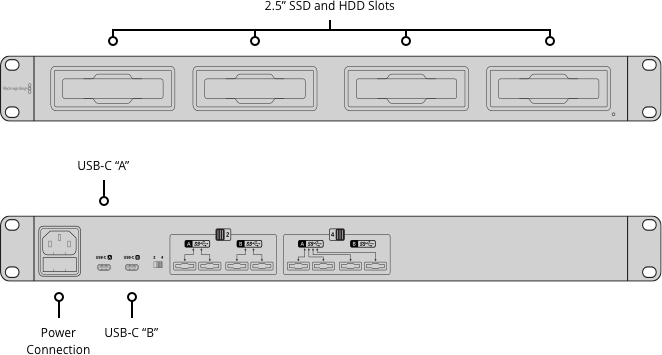
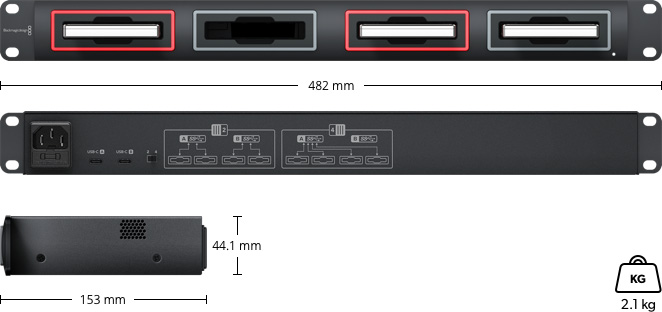
This high‑performance solid‑state disk dock is engineered for professional film and television workflows where speed, reliability and efficient media handling are essential. Designed as a compact 1 RU rack‑mount unit, it allows up to four independent 2.5‑inch SSDs to be accessed simultaneously through a single high‑speed USB‑C connection operating at 10 Gb/s. The enclosure is built entirely from metal, giving it the durability required for permanent installations in machine rooms, mobile racks or on‑set environments.
Unlike consumer SSD adapters, this dock uses an independent SATA driver chip for each disk bay. This architecture ensures consistent performance across all four slots, even when multiple disks are accessed at the same time. Media can be edited directly from the inserted drives without copying files to internal storage, which significantly speeds up post‑production workflows. All disks mount natively on macOS and Windows systems without the need for additional drivers or software.
The rear panel includes two USB‑C 3.1 Gen 2 connections, each capable of 10 Gb/s throughput. A built‑in selector allows the unit to operate in different connection modes, either exposing all four disks over a single USB‑C connection or splitting the bays across two connections for shared access. This flexibility makes it suitable for collaborative environments or high‑bandwidth workflows, including RAID configurations for increased performance.
Each drive slot features an illuminated activity indicator so disk access can be monitored at a glance. The design is serviceable, allowing individual socket connectors to be replaced if required, which extends the operational lifespan in demanding professional use. Power is supplied by an internal universal AC power supply supporting 100 to 240 V, providing stable operation even when all four bays are populated with high‑performance SSDs.
This dock is also designed to integrate seamlessly with Blackmagic recording hardware. When paired with devices such as HyperDeck Extreme 8K HDR, it adds direct SSD recording and playback capability, allowing disks to be easily exchanged between recording and editing systems. This makes it an efficient bridge between acquisition and post‑production in modern high‑resolution workflows.