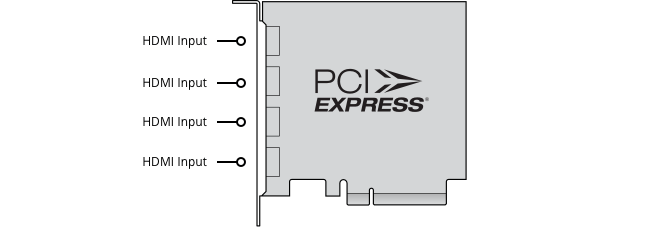
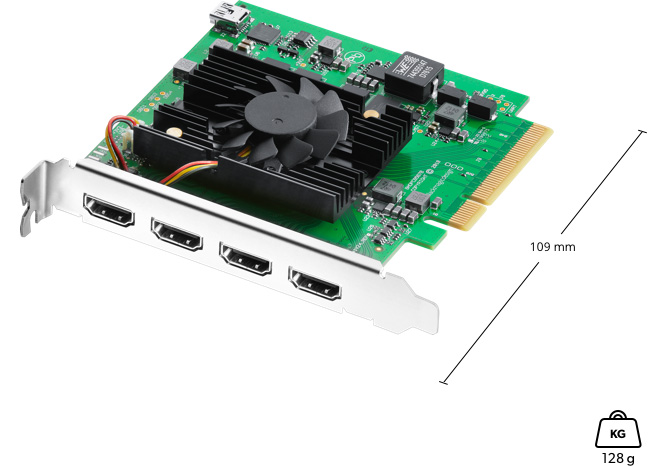
DeckLink Quad HDMI Recorder is a high‑performance PCIe capture card engineered to ingest four independent HDMI sources simultaneously in any mix of SD, HD, Ultra HD, DCI 4K and computer display formats, making it ideal for software live switching, multi‑screen streaming, gameplay capture and production ingest.
Its four HDMI 2.0b inputs operate as fully independent channels, so each connector can capture a different resolution, frame rate and color sampling at the same time, effectively giving you the flexibility of four customizable capture cards on a single low‑profile board.
Professional color fidelity is assured with support for 8‑, 10‑ and 12‑bit RGB 4:4:4 up to 4Kp30, as well as 8‑ and 10‑bit YUV 4:2:2 across all modes, plus 4:2:0 at 4K and Ultra HD 50/60p, enabling accurate keying, grading and graphics‑rich workflows.
Broad standard coverage includes SD 525i59.94 and 625i50, HD up to 1080p60 and 1080i60, Ultra HD up to 2160p60, DCI 4K up to 60p and a wide range of DVI computer resolutions up to 2560×1600p60, so you can capture from cameras, consoles and workstations without format converters.
Each channel supports eight channels of embedded HDMI audio at 48 kHz/24‑bit, maintaining perfect AV sync for multi‑source productions and eliminating external de‑embedders.
A PCI Express Gen 3 x8 interface ensures the bandwidth required for four concurrent high‑data‑rate inputs and integrates seamlessly into macOS, Windows and Linux workstations; installation and configuration are streamlined with the included Blackmagic Desktop Video tools such as Media Express, Disk Speed Test and Desktop Video Utility.
The card works with popular production and streaming software including Wirecast, vMix and OBS, and is compatible with additional ingest and playout applications like Cinegy Capture Pro, Softron MovieRecorder and ToolsOnAir just:in, giving system integrators a broad ecosystem for live production and automated capture.
Color management covers Rec. 601, Rec. 709 and Rec. 2020, with HDMI 2.0b features such as Deep Color and HDR supported, so SDR and HDR pipelines remain consistent from source to edit.
Codec flexibility spans ProRes, DNxHR/DNxHD, DPX, XDCAM, AVCHD and uncompressed 8‑/10‑bit 4:2:2, ensuring your captured media drops directly into established editorial and finishing workflows without transcoding.